
 English
 Türkçe
 Русский
 Español
 Français
 Deutsch
 한국어
 中文
 Български
 हिन्दी
 Indonesia
 Italiano
 日本語
 Melayu
 Português
 Svenska
 العربية


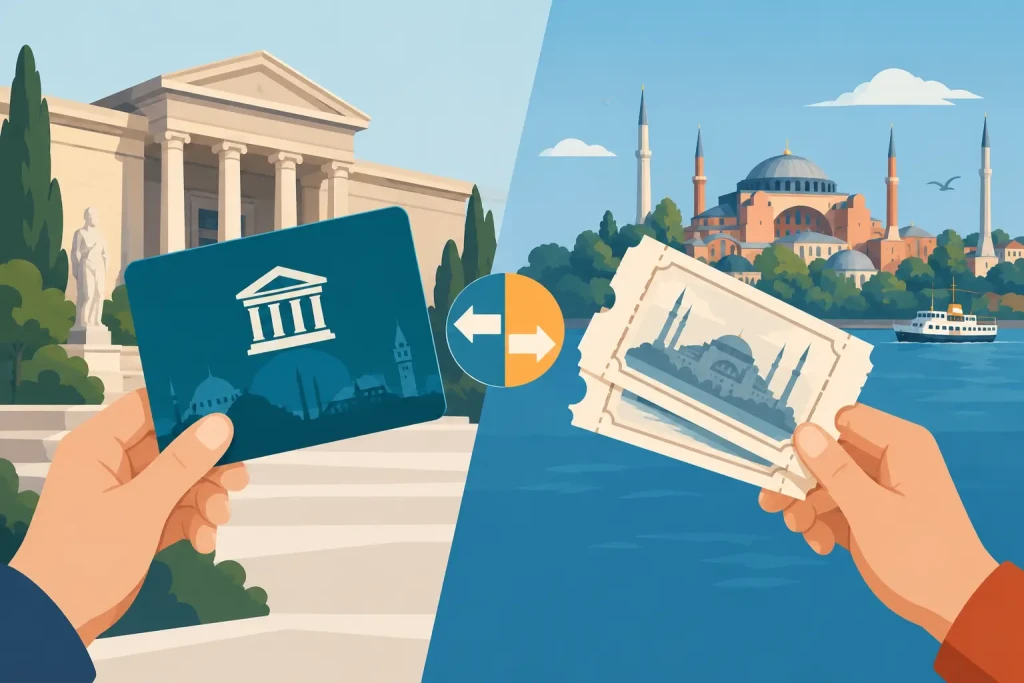
A day in Istanbul can disappear faster than most visitors expect. Security lines, ticket queues, the walk between major sites, and a well-earned Turkish coffee all take time. The museum pass versus tickets decision is therefore not only about admission cost. For travelers with a tight layover, a cruise departure, or just two days in the city, it is a decision about how much of the day you want to spend waiting.
A museum pass can be excellent value when your itinerary includes several participating state museums within its validity period. Individual tickets are often the smarter choice when you want only one or two specific attractions, have a flexible schedule, or plan to visit places that are not covered by the pass. The right answer depends on your route, travel pace, and the attractions that matter most to you.

An individual ticket gives admission to one attraction, on one visit. It is straightforward: you decide where to go, purchase entry for that site, and pay only for what you use. This approach suits visitors who want a focused day around the Blue Mosque area, a Bosphorus cruise, shopping, or neighborhoods such as Karakoy and Kadikoy rather than a full museum program.
An Istanbul museum pass is designed for travelers visiting multiple participating museums over a set number of days. Rather than buying a separate entry ticket at every eligible site, you make one purchase and use it across the pass network according to its current rules. It can reduce repeated ticket purchases and, at some venues, may provide access through a dedicated entrance procedure.
The key word is participating. Istanbul has an extraordinary mix of government museums, municipality-operated sites, religious landmarks, private museums, palaces, and experiences with separate ticket systems. A pass does not automatically cover every famous attraction you see in travel photos. Before purchasing, review the current official list of included sites, validity period, entry conditions, and any reservation requirements.
A pass is most likely to make financial sense if you can realistically visit three or more eligible museums. Start by listing the places you genuinely plan to enter, not every landmark you may pass on the way. Add the current individual admission prices, then compare that total with the pass price. If the savings are small, time and convenience should decide the purchase.
It works particularly well for visitors who enjoy archaeology, Ottoman history, art, and palace collections. A traveler spending a full day around Sultanahmet and another day crossing to the Beyoglu or Golden Horn side may have enough time to use a pass well. A family with older children who enjoy museums may also appreciate settling the admission budget in advance.
The pass can also simplify planning when you prefer not to make a payment decision at every door. That convenience has value, especially after an international flight or during a short city break. You still need to budget for transportation, food, guides, and attractions outside the program, but museum admissions become easier to manage.
There is one practical caution: a pass only saves money when you use it. Istanbul’s major attractions deserve time. Trying to visit too many museums simply to justify a pass can turn a memorable visit into a rushed checklist. It is better to see fewer places properly than to spend the afternoon watching the clock.
Choose a pass when you have multiple full sightseeing blocks, a clear interest in the included collections, and a route that keeps travel time between venues reasonable. It is often a good option for independent travelers staying centrally for several days.
It can also suit travelers on a private tour when the selected itinerary includes several covered museums. Your guide can help organize the order of visits and explain what requires separate payment, so there are no surprises at the entrance.
Individual tickets are usually better for a short layover, a cruise port call, or a one-day Istanbul itinerary. These travelers may only have time for one major museum alongside the Blue Mosque, Hippodrome, Grand Bazaar, Spice Market, or a Bosphorus experience. A multi-day pass may be unnecessary even if it looks attractive at first glance.
Tickets also make sense if your must-see list includes attractions commonly handled outside a museum pass. Hagia Sophia has had changing visitor access arrangements, while religious areas, palace sections, private museums, observation points, and special exhibitions can follow their own admission policies. Never assume that a pass covers a site without checking the current conditions before your visit.
If you are traveling with children, consider their attention span as carefully as the ticket price. One well-chosen museum, a relaxed lunch, and time to explore may be much more enjoyable than several paid entries in one day. The same is true for travelers arriving after an overnight flight.
Individual admission is also the flexible choice for visitors who dislike fixed plans. Istanbul weather, traffic, crowds, and personal energy can change the day. Paying only for the museum you enter lets you adjust without feeling pressure to maximize a pass.
A museum pass can reduce ticketing friction, but it does not eliminate airport-style security screening. At popular sites, all visitors may need to pass through security, and lines can be longer during holiday periods, school breaks, weekends, or when several cruise ships are in port.
It also does not replace a licensed guide. Museum labels provide useful facts, but they rarely connect Byzantine Constantinople, Ottoman court life, religious traditions, and modern Istanbul in a way that makes the city’s layers easy to understand. A knowledgeable private guide can add that context and adjust the route when a venue is crowded or temporarily unavailable.
Most importantly for time-sensitive guests, a pass does not manage transportation or return timing. A cruise guest needs a realistic buffer for returning to Galataport. A layover traveler must account for airport procedures, road conditions, and terminal return time. Admission savings are never worth risking a flight or ship departure.
Build your plan around time first and tickets second. Confirm how many hours you actually have in central Istanbul after airport or port transfers, security, and your required return buffer. Then choose no more than two major indoor attractions for a half-day and two to three for a full day, depending on their size and distance.
Next, separate your list into three groups: sites included in the current pass, sites requiring separate tickets, and free or exterior stops. This immediately shows whether a pass will serve your real itinerary. Do not include attractions simply because they are famous if they are not a personal priority.
Finally, check opening days and operating hours close to your travel date. Museums may have weekly closing days, adjusted hours, temporary gallery closures, or special rules during religious holidays and national events. Current terms can change, so the details available when you book should be the details you use for planning.
For a private itinerary, share your priorities before the tour begins. Eternal Wonder Tours can help organize a route that accounts for your available time, admission needs, private transportation, and a dependable return to your airport or cruise port. That is especially helpful when several attractions have different ticket rules.
The lowest admission cost is not always the best value. If buying separate tickets lets you spend an unhurried hour at a museum you truly care about and still return comfortably to your ship, that is a successful day. If a pass lets you visit several collections without repeated ticket purchases, it may be the more efficient option.
Choose the option that fits the Istanbul you actually want to experience, leaving room for the unexpected moments that make the city memorable: a call to prayer across Sultanahmet, a ferry crossing in the late afternoon, or a conversation over tea. A well-paced plan will serve you better than any pass or ticket purchased for the wrong itinerary.











 info@eternalwondertours.com
 +90 5357094145
